


Towards minimising Projection in all relationships
- Memory
- Sep 9, 2021
- 5 min read
1. Giving and receiving feedback to promote learning conversations.
2. Learning to love and include yourself.
If you want to improve your relationships and have a quality life, identify and minimise projection. The best way to minimise projection is to learn to love on three levels and apply the SIFTSEM tool or objective evaluation. This is because projection is a defensive mechanism to avoid your emotions while focusing on someone or something. When you project, you cannot sit with the uncertainty of life. Yet, that on its own is a necessary life skill that helps with peacefulness.
Improving relationship outcomes comes with taking responsibility during self-development. During self-development, You develop self-awareness and self management tools. You learn to pay attention to choices, decisions, behaviour, attitude, words , thoughts and feelings. Through this, you can gradually improve your self-relationship. Paying attention to your self-talk which you then express to others in the words you speak, how you communicate and behave is likely to improve the quality of your relationships. Using strong language or actions is an act of self-abuse because everything you say or do starts in the core of you.
In support communities and relationships, you can learn to take responsibility for your life. You are invited to look within to avoid bleeding on others. To learn to be comfortable with the pause following discomfort that comes with the urge to react, or take action without reflection.
This action might look like ; Attacking others verbally or physically, Passive aggressive behaviour or posts on social media,
Drama in your life and relationships, Focusing on other people and their problems or mistakes, Calling people names,
Blame and judgementalism, Projecting insecurities on others
Loving too much or giving to get! Rather than sitting to reflect on what you are doing, why you are doing it and what you can do differently, you simply take action which violates other people's boundaries.
Bringing your story into every conversation.
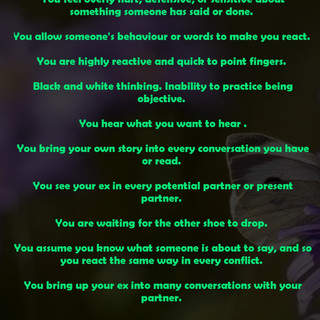
When you project, you avoid your emotions and focus on something else or someone as the source of your discomfort.
These are the very reasons your relationships might suffer. You are the same person with these attitudes and behaviours. You take them into your relationships. You might have this habit where you do not pause to reflect on what you are feeling and why you are feeling it. Reflecting on how you are feeling can give you an opportunity to practice the dichotomy of control.
During the pause, you can self-parent and, consider other perspective, and then express your needs with vulnerability.
If you have this pattern of reacting, not only will your partner and friends get turned off, your children also observe the way you behave. The result is you are transmitting your dysfunctional patterns. You recycle your behaviours and release more individuals in the world who will create dysfunctional families.
Here is how we recommend giving and receiving feedback in this community, and in healthy relationships :
You do not need to be angry on behalf of anyone!
1. Lean into your emotions. They are trying to tell you somethimg.
Manage your trigger, by feeling and naming your feelings, finding the root cause, self-soothing with five love languages, cathartic shake and creating solutions. You may then move on.
2. Learn to own your experience. Everything is perception.
Yes, you might feel strongly about something someone says or does, and that is OK. You do not need to take action without reflection though.
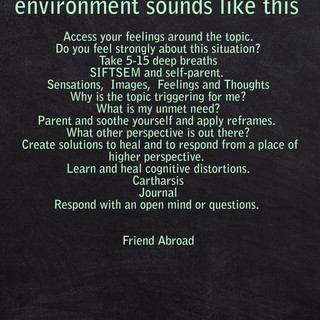
▪︎ Pause Take a step back before you respond.
There is no rush to say anything too fast.
There is no rush to get a text right now! Breathe in and out. What is your trigger score? Yes, even if you are responding to a post you score!
Scan your body for Sensations, Images, Feelings and Thoughts.
▪︎Explore root cause. Why do you feel strongly about this matter? Why do you need to jump into action?
Is it something you experienced or observed in the past?
▪︎What would healthy parenting look like in this situation? Parent and soothe just like what a mother would do for a child who is worried, confused or distressed.
•Hugs, gratitude, words of affirmations, rocking, cathartic shake.
• Reframes and role reversal
Look into your cognitive distortions and learn higher perspective.
Be teachable, you have a lot to learn from everyone too.
Is this a personal issue? Is what you are thinking true?
What else could this mean? Consider, what other perspective is out there? What is not being said? What might the other involved person think and feel about this?
REMEMBER..You do not know the whole story , even about someone you sleep next to.
▪︎ Solutions 1. What can you do to help yourself and prevent, eliminate, minimise or minimise impact of these triggers?
2. Advice - What can you say to help this person NOT to enable? What could be done differently to help this person, not to focus on the problem?
When you feel strongly about a topic, use " I feel " or "Here is what I learnt about this from ..." " Here is my suggestion or recommendation " " I find it hard to.." statements.
3. Adopt an open mind. Ask questions. (It is easy to conclude, but again, you do not have the whole story.)
4 Do not avoid conversation because someone disagrees.
However, learn to create learning conversations, without jumping to conclusions.
Consider responses and timing. Consider how you are expressing yourself.
5. Learn to reframe your negative thoughts to avoid a pattern of complaining.." I understand that it is challenging to start healing work, but I am going to give it a go!" Learn to "try" rather than to label something you have not attempted to do.
6. Loving too much . Sit with your urge to take action or overfunction, and parent and soothe. Create solutions to put that love towards your life and wellbeing where it belongs.
SIFTSEM and objective evaluation acknowledge how you feel, but without bleeding on yourself and others.
Without projecting your lack of love and affection on a partner.
Without putting your story in every conversation.
Advice....When they come to you or you read posts...
It is important to be objective when people come with their stories also. There is a lot to unpack in those stories. A lot we do not know. A lot of gaps. Intention might be hidden.
Observe the patterns of their stories also. You might identify something you can apply to help them.
You do not call anyone names without calling yourself those names first. In fact, as you call someone something, it applies to you first! It has foremost passed through you. It was decided by your inner court, so it applies to you foremost.
Objective evaluation
That is why we recommend that people learn SIFTSEM or objectively evaluating every situation. That is called mindful living. You do not need to sit for 30 minutes doing the exercise. Practice makes it a part of life and helps you ask yourself what you are about to do, the why and what you can do differently.
Root cause analysis is pivotal for decision making. We each have answers within us. SIFTSEM helps you access your inner resources and create learning conversations. It also helps the person requesting advice to share their fondings for further recommendations from a support community.
No, you do not need to stop asking questions or seeking support. The invitation is that you learn to apply, "Love on three levels" instead.
Initially, while learning SIFTSEM on the First Level of self-support and self-love, you need regular support on the Second level with your immediate support circle.
When you are able to apply SIFTSEM, you share your SIFTSEM for support with solutions and other areas as required.
When you are competent, you can easily make decisions, but you might occasionally still reach out with a SIFTSEM to discuss with your immediate circle. This prevents unhealthy venting and dependence. You minimise pressure and negativity in your relationships.
As you become more empowered in your decision making, you welcome your emotions and sit with them. You not only focus inwards, but also create healthy conversations with others as you learn to manage projection.



Comments